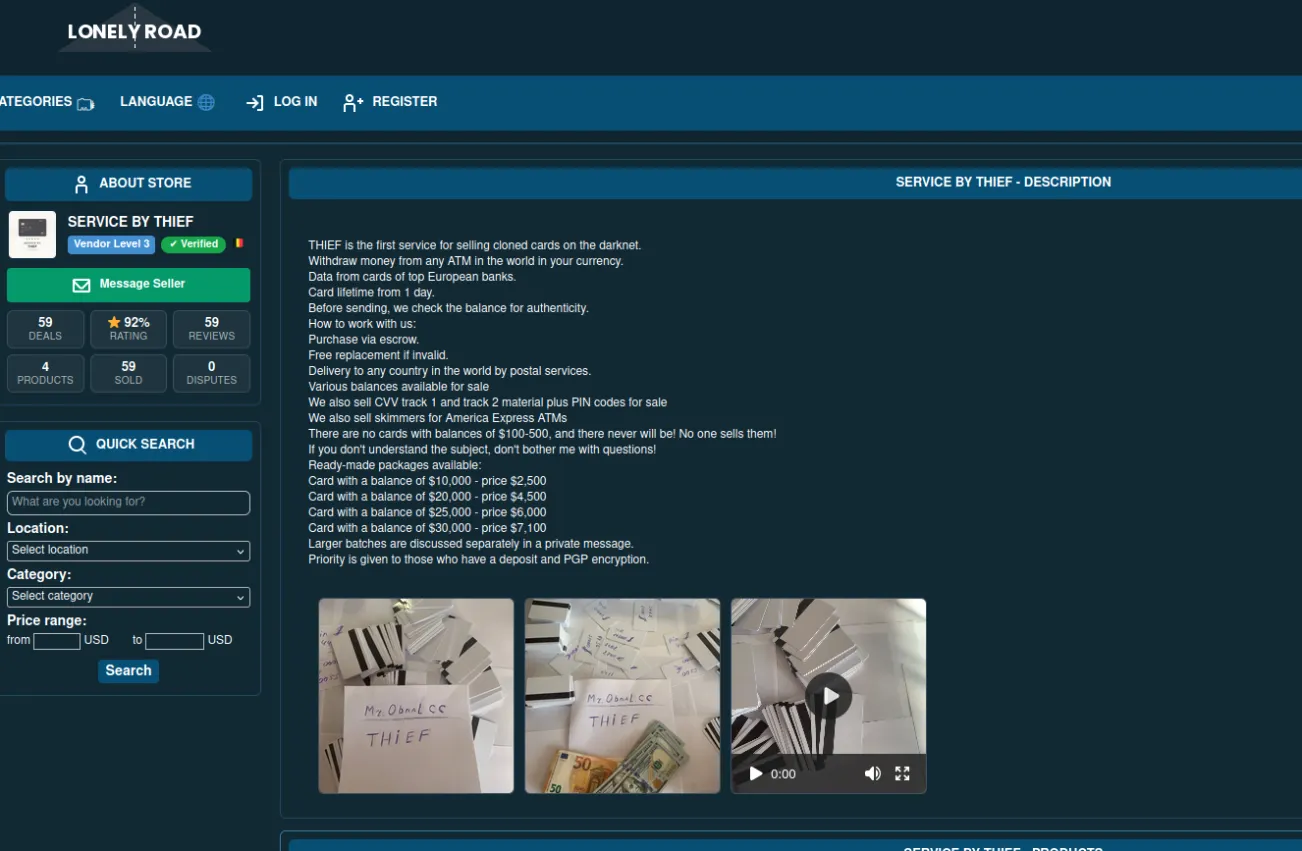
The dark web operates through .onion domains accessible only via Tor Browser, hosting marketplaces where carding — the sale of cloned credit and debit card data — represents one of the oldest and most persistent criminal economies. These platforms offer magnetic stripe dumps, embossed cards with PIN codes, and tutorials on cashing out stolen funds. Buyers believe that cryptocurrency payments and Tor routing shield their identity, yet investigative techniques have evolved to bridge the gap between digital anonymity and physical evidence.
A November 2024 incident involving a Tampa Bay resident illustrates this evolution. The individual purchased six cloned debit cards with PIN codes from a darknet marketplace for $480 in cryptocurrency, withdrew $4,900 from four ATMs, and was arrested 15 days later. The investigation relied on ATM surveillance footage, transaction pattern analysis, and cryptocurrency tracing through Know Your Customer (KYC) exchanges. The case concluded with a 60-month federal prison sentence, a $22,000 fine, and three years of supervised release.
This analysis examines how carding operations function on dark web onion links, the technical vulnerabilities that compromise user anonymity, and the forensic methods that law enforcement employs to trace digital crimes to physical actors. The focus remains on the investigative chain rather than operational guidance, emphasising the intersection of cybersecurity, financial fraud detection, and physical surveillance infrastructure.
What are dark web onion links and how do carding markets operate?
Dark web onion links use the .onion pseudo-top-level domain, accessible exclusively through Tor Browser or similar anonymising networks. These addresses consist of randomly generated alphanumeric strings — typically 16 or 56 characters — that resolve through Tor's hidden service protocol. Unlike clearnet domains, .onion sites do not appear in standard search engines and require specific software to access. This architecture provides server-side anonymity: the physical location and IP address of the hosting infrastructure remain concealed from visitors and law enforcement.
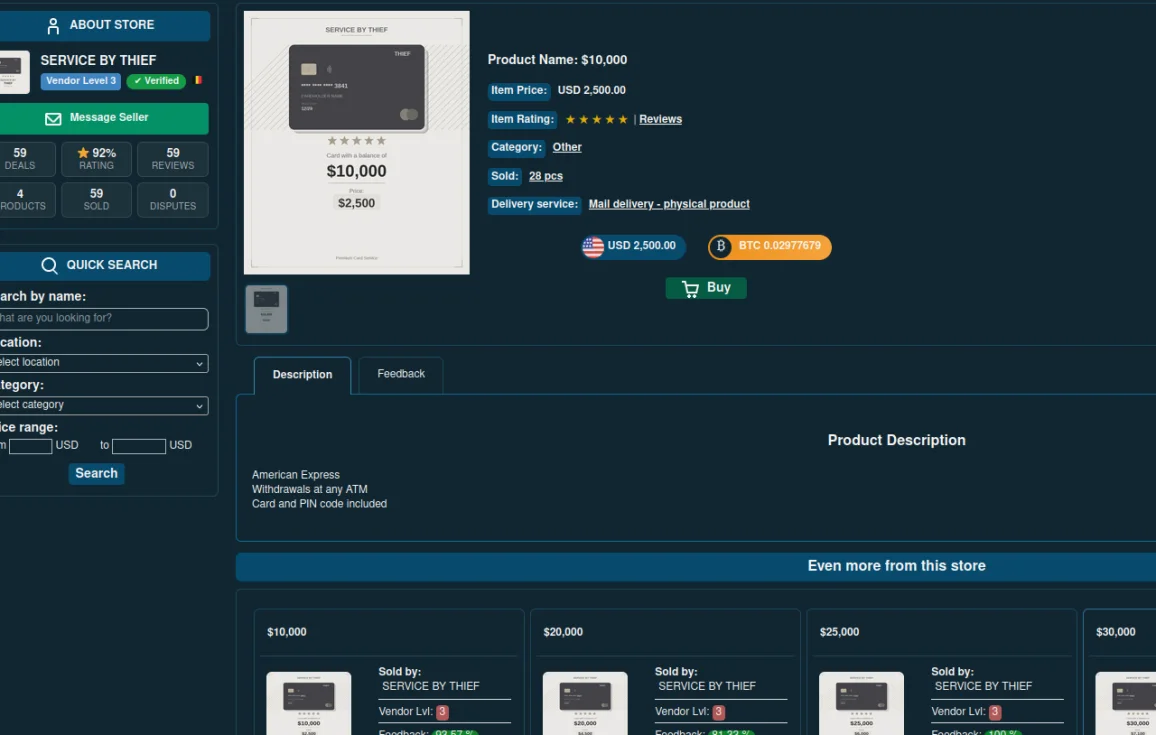
Carding forums dark web constitute a significant portion of this hidden economy. These marketplaces list stolen credit card data in various formats: full magnetic stripe dumps (track 1 and track 2 data), card verification values (CVV/CVV2), and personal identification numbers when available. Vendors organise listings by card type (Visa, Mastercard, American Express), issuing bank, country of origin, and account balance range. Prices vary from $5 for a single CVV to $480 for a set of six embossed cards with PIN codes, as documented in the Florida case.
The transaction workflow follows a standardised pattern. A buyer registers on a marketplace, deposits cryptocurrency into an escrow account, selects a card listing, and completes the purchase. The vendor then ships physical cloned cards via postal services or transmits digital dumps through encrypted messaging. Escrow release occurs after the buyer confirms receipt, though disputes arise when cards are blocked before use — a common occurrence that marketplaces address through rating systems and vendor guarantees. This structure mirrors legitimate e-commerce platforms, adapted for illicit goods and cryptocurrency-only payments.
Cloned cards reddit discussions frequently reference these marketplaces, with users sharing vendor reviews, cashout techniques, and anti-fraud evasion methods. However, such discussions also attract law enforcement monitoring. Posts detailing successful withdrawals or vendor recommendations provide investigative leads, while forum administrators struggle to balance operational security with community engagement. The visibility of these conversations on surface web platforms like Reddit paradoxically undermines the anonymity that dark web onion links are designed to provide.
How do criminals obtain card data for cloning operations?
Credit card skimming device detector technology exists to identify illicit hardware, yet skimmers remain a primary data acquisition method for carding operations. Physical skimmers attach to ATM card slots or petrol station payment terminals, capturing magnetic stripe data as legitimate users insert their cards. These devices vary in sophistication: basic models record track data to internal memory for later retrieval, whilst advanced variants transmit data wirelessly via Bluetooth or GSM to nearby receivers. ATM skimmer images circulated by law enforcement show devices ranging from crude plastic overlays to precision-moulded units indistinguishable from genuine card readers.
How to check for credit card skimmers involves physical inspection before card insertion. Legitimate card slots fit flush with the ATM fascia and resist movement when pulled or twisted. Skimmers often protrude slightly, feel loose, or exhibit colour mismatches with surrounding hardware. How to tell if a card reader has a skimmer also requires examining the keypad: overlays that capture PIN entries may sit atop genuine keys, creating a raised or spongy feel. How to tell if there is a card skimmer includes checking for pinhole cameras near the keypad or card slot, though modern shimmer devices — thin electronic circuits inserted into the card reader's internal mechanisms — evade external detection entirely.
Card skimming protection measures deployed by financial institutions include EMV chip technology, which generates unique transaction codes that cannot be reused even if intercepted. However, magnetic stripe fallback remains available on most cards for compatibility with older terminals, creating a vulnerability that skimmers exploit. Credit card skimmer protection for consumers includes using chip-insertion rather than swiping when possible, covering the keypad when entering PINs, and monitoring account statements for unauthorised transactions. Credit card skimmer protector devices — RFID-blocking wallets and contactless card shields — address wireless skimming but do not prevent physical skimmer attacks at ATMs.
Card skimming protector technology on the institutional side includes anti-skimming jitter mechanisms that vary card insertion speed, making it difficult for skimmers to read magnetic data cleanly. Card skimming reddit threads document these countermeasures, with users noting that newer ATMs employ motorised card readers that pull cards entirely into the machine, leaving no external slot where a skimmer could attach. Credit card skimming protection also extends to transaction monitoring: banks flag unusual withdrawal patterns — such as multiple ATM visits in different states within hours — triggering automatic card blocks and fraud alerts.
CF card cloning, though the abbreviation more commonly refers to CompactFlash memory cards in photography, occasionally appears in discussions of card duplication equipment. Magnetic stripe read/write devices (MSR606, MSR605) purchased legally for access control systems serve dual purposes in carding operations. These devices encode stolen track data onto blank PVC cards, creating functional clones. The Florida case documented seizure of such equipment during the search, providing direct physical evidence linking the accused to card production.
Why does ATM surveillance compromise anonymity more than digital forensics?
Modern ATMs function as evidence collection systems rather than mere cash dispensers. Built-in cameras record at 1080p resolution with infrared capability for low-light conditions, capturing facial features in detail sufficient for database comparison. Transaction logs record withdrawal time accurate to the second, amount, card number, ATM identifier, and GPS coordinates. Network logs preserve processor communication metadata, including connection timestamps and response codes. This multi-layered data architecture creates a forensic package that links digital transactions to physical actors.
The Tampa Bay case demonstrates this convergence. The individual made no attempt at facial concealment — no mask, glasses, or hat — during the fourth ATM withdrawal. Twenty-three seconds of video footage provided a clear facial image that investigators matched against Florida Department of Public Safety driver's licence databases. The comparison returned a single match with home address, eliminating the need for further identification steps. This contrasts sharply with the cryptocurrency trail, which required court orders, exchange cooperation, and timeline correlation to establish probable cause.
Geographic pattern analysis amplified the surveillance advantage. All four ATM withdrawals occurred within a 40-mile radius of the accused's residence over two weeks. Anti-fraud algorithms automatically flag such patterns: legitimate cardholders rarely make rapid withdrawals across multiple states unless travelling, and travel patterns typically show directional progression rather than clustering. The bank's early fraud warning system identified this anomaly on day three, two days before human analysts reviewed the case. Automated detection systems thus provided the initial alert that triggered manual investigation.
Video evidence also circumvents the limitations of cryptocurrency anonymity. Whilst Monero transactions resist blockchain analysis, the visual record of a face at a specific location and time constitutes direct evidence that requires no cryptographic tracing. Even if all digital evidence had been perfectly anonymised, the ATM footage alone would have sufficed for identification and prosecution. This explains why professional carding operations emphasise recruiting «mules» — individuals who perform physical cashouts in exchange for a percentage — to insulate organisers from surveillance exposure.
How did cryptocurrency tracing contribute to the investigation?
The accused purchased Monero specifically for its privacy features: ring signatures obscure transaction origins, stealth addresses prevent recipient tracking, and ring confidential transactions hide amounts. Unlike Bitcoin, where blockchain analysis firms trace fund flows through transparent ledgers, Monero's protocol design renders such analysis impractical. This technical advantage collapses at the fiat-crypto interface where KYC regulations apply.
Centralised exchanges in jurisdictions with anti-money laundering (AML) requirements mandate identity verification before permitting cryptocurrency purchases. The individual completed KYC on such an exchange, uploading passport scans and a facial photograph. When investigators obtained a court order, the exchange provided account details, purchase history, and the exact date and amount of Monero acquisition. This data point — $480 worth of Monero purchased 72 hours before the first ATM withdrawal — correlated with the darknet marketplace transaction, establishing a timeline that linked digital and physical events.
The investigative chain did not require tracing Monero's movement after purchase. The mere fact of acquisition in the relevant amount during the relevant timeframe, combined with ISP records showing Tor exit node connections during marketplace browsing hours, created sufficient circumstantial evidence. Browser history recovered from the seized laptop confirmed visits to the marketplace's .onion address, whilst packaging materials matched the vendor's shipping methods documented in marketplace reviews.
This case illustrates a fundamental principle: cryptocurrency anonymity protects transactions, not identities. The entry point (fiat-to-crypto conversion) and exit point (crypto-to-fiat or crypto-to-physical goods) remain vulnerable to traditional investigative methods. Peer-to-peer exchanges and Bitcoin ATMs offer alternatives to KYC exchanges, yet both introduce different risks: in-person meetings create surveillance opportunities, whilst Bitcoin ATMs increasingly implement identity verification under regulatory pressure. No technical solution eliminates the need to convert cryptocurrency into usable value, and that conversion point remains the weakest link.
What physical evidence proved decisive in prosecution?
The search warrant executed on day 14 yielded six blank PVC cards, a magnetic stripe read/write device, a laptop with Tor Browser history, $3,200 in cash, and shipping packaging. Each item served a distinct evidentiary function. The blank cards contained encoded magnetic stripe data matching tracks stolen from verified fraud victims, providing direct physical proof of cloning activity. Forensic comparison confirmed that track data on seized cards corresponded byte-for-byte with data skimmed from legitimate accounts.
The MSR device — a commercially available MSR606 encoder — contained residual magnetic data in its buffer memory. Forensic extraction recovered fragments of additional card tracks beyond those found on the physical blanks, suggesting prior encoding activity. Whilst not sufficient for additional charges, this evidence demonstrated ongoing rather than isolated criminal activity, influencing sentencing considerations. Device purchase records traced through the manufacturer's distributor network showed acquisition six weeks before the first withdrawal, establishing premeditation.
Cash denominations matched ATM dispensing patterns. The first three ATMs distributed specific bill combinations: $700 in $20 notes, $1,500 in mixed $50 and $20 notes, and $2,000 in $100 notes. The seized $3,200 contained bills in proportions consistent with these dispensing patterns, accounting for partial spending. Serial number analysis confirmed that 40% of seized bills originated from the specific ATM machines documented in transaction logs. This correlation, whilst not definitive alone, reinforced the prosecution's timeline.
Laptop forensics recovered deleted browser history through file system analysis. Tor Browser's private browsing mode prevents local history storage, yet operating system swap files and thumbnail caches preserved fragments of .onion URLs and marketplace screenshots. Timestamps on these files aligned with the Monero purchase date, providing corroborating evidence of marketplace access. Investigators also recovered encrypted chat logs from a messaging application, though encryption prevented content analysis. Metadata alone — message timestamps and contact identifiers — sufficed to demonstrate communication patterns consistent with vendor negotiations.
What sentencing factors influenced the 60-month term?
Federal sentencing for access device fraud under 18 U.S.C. § 1029 calculates based on loss amount, number of victims, and role in the offence. The $4,900 withdrawn fell below the $10,000 threshold that triggers enhanced penalties, yet three separate victims across three states elevated the offence level. The U.S. Sentencing Guidelines assign points for each victim beyond the first, incrementally increasing the recommended range. With three victims, the base offence level increased by two levels.
The accused's role as a buyer rather than organiser provided a mitigating factor. The court acknowledged that the individual did not operate the skimming infrastructure, manage the marketplace, or recruit additional participants. This distinction mattered: organisers in similar cases receive 10 to 15-year sentences, whilst cashout operatives typically receive 3 to 7 years. The 60-month term positioned the sentence in the middle of the range for end-user carding offences, reflecting culpability without organisational aggravation.
Acceptance of responsibility through a guilty plea reduced the sentence by approximately 12 months. Federal guidelines reward plea agreements that conserve judicial resources and spare victims from testifying. The individual cooperated during interviews, providing details about the marketplace's user interface and vendor communication methods, though this cooperation did not extend to identifying the vendor — likely because the vendor's identity remained unknown even to the buyer, a common anonymity practice on dark web platforms.
Restitution of $22,000 exceeded the $4,900 withdrawn, accounting for bank investigation costs, card reissuance expenses, and victim compensation for time spent resolving fraudulent charges. Federal courts routinely include indirect costs in restitution calculations, recognising that fraud's economic impact extends beyond direct theft. The three-year supervised release term includes conditions prohibiting cryptocurrency use and requiring financial disclosure, standard provisions for fraud convictions aimed at preventing recidivism.
What systemic vulnerabilities enabled rapid identification?
Anti-fraud systems operated automatically before human intervention. Pattern recognition algorithms identified the geographic clustering of withdrawals within 72 hours, flagging the case for manual review. Machine learning models trained on historical fraud data assign risk scores to transactions based on velocity (number of transactions per hour), geographic dispersion, and deviation from cardholder behaviour baselines. When multiple cloned cards from different accounts exhibit identical usage patterns, the system infers a common source and escalates the alert priority.
Integration between banking networks and law enforcement databases accelerated identification. The U.S. Secret Service maintains direct access to early fraud warning system feeds from major banks, receiving real-time alerts for cases meeting specific criteria: multi-state activity, cloned cards, or losses exceeding $5,000. This integration eliminated the delay inherent in manual case referral, reducing response time from weeks to days. The Florida case proceeded from initial fraud detection to arrest in 15 days, a timeline that reflects institutional coordination rather than exceptional investigative speed.
Driver's licence databases provide facial recognition infrastructure that commercial systems cannot match. State motor vehicle departments maintain high-resolution photographs linked to addresses, biometric measurements, and identifying marks. When investigators obtained the ATM facial image, automated comparison against Florida's database returned a match confidence score above 95%, meeting the threshold for probable cause. This capability exists in most U.S. states and European Union countries, though legal frameworks governing its use vary significantly.
The case also revealed the limited protection that dark web onion links provide against physical evidence. Postal interception, controlled deliveries, and package tracking analysis remain outside Tor's threat model. The vendor shipped cards via standard postal services, generating tracking numbers that investigators later correlated with delivery dates and the accused's residence. Had customs or postal inspectors flagged the package during transit, a controlled delivery could have provided evidence before any withdrawal occurred, though this did not happen in the documented case.
How effective is dark web anonymity against physical surveillance?
The Florida case demonstrates that dark web onion links provide transactional anonymity but cannot shield physical actors from surveillance infrastructure at cash withdrawal points. ATM cameras, transaction pattern analysis, and KYC-compliant cryptocurrency exchanges create a forensic chain that bridges digital and physical evidence. The 15-day timeline from first withdrawal to arrest reflects systemic integration between banking anti-fraud systems, law enforcement databases, and facial recognition technology rather than individual investigative brilliance. For security professionals, the case underscores the importance of multi-layered defence: client education on card skimming protection, investment in machine learning fraud detection, and coordination with law enforcement through standardised data-sharing protocols. The organisers higher in the carding supply chain — those who operate skimming infrastructure and manage marketplaces — remain more difficult to identify, as they avoid physical exposure. Yet the case illustrates that end-users who perform cashouts bear disproportionate risk, a reality that dark web marketplaces rarely advertise to buyers. The 60-month sentence and $22,000 financial penalty serve as quantifiable deterrents, though whether such consequences reduce participation in carding markets remains an empirical question that recidivism studies continue to examine.
For further analysis of darknet security architecture and investigative methodologies, TorNest provides ongoing coverage of cases where digital anonymity intersects with physical evidence collection.
Further services. These services are useful starting points for further research. Recommended services